Lcd Monitor Calibration Charts Download
Monitor calibration and gamma Making fine prints in your digital darkroomMonitorcalibration and gammaby NormanKoren updated June 8,2005Help support this site by linking to thesemerchantsorSearch WWW Searchwww.normankoren.comTable ofcontentsfor theMaking FinePrintsseries for Image editingwithPictureWindow Pro In this page we discuss a critical step in setting up a digital darkroom:calibrating your monitor so it conforms to widely-accepted standards of imagedisplay. A properly calibrated monitor is essential for making prints that matchthe monitor image; it is an absolutenecessity for success in the digital darkroom. Is now on a separate page.This page makes little mention of - a set of tools and techniques that enable you toachieve optimum monitor/print matching and make prints with nonstandard inks andpapers.
You don't need it to get started. It involves a learning curve, but it'ssimple to use once you've mastered it.
Otherwide it's error-prone. I now use afully color-managed workflow.Relatedpages:discusses how to get your prints to match your monitorimage.covers some background areas related to gamma. Wediscuss (many old ones had an error), then we presenttwo additional charts: one for, one for (R, G, B). We illustrate what luminance steps look like fordifferent gamma settings, then discuss pages by, which contain some dubious advice about gamma. Thismaterial on this page is for reference; it's not essentialreading.Sooner or later you'll have to face it if youwant to make the finest possibleprints.Setting up your monitor.
Your monitor should be operated in subdued light; strong direct lightshould not reach the screen. Dark areas of the screen should appear dark tothe eye. I work in a semi-darkened room with a lamp to the left of my screen(positoned so no direct light reaches the screen). Total darkness isunnecessary.
CreativePro.com has nice articles about and. Set your monitor's color temperature (white point) to 6500K, D65, or sRGB,which is equivalent to 6500K.
This is preferable to setting it on or software. My monitor selections are 5000K (D50), 6500K (D65),and 9300K. Older monitors with no color temperature setting default to around9000-9300K, which is far too blue to comfortably match prints viewed underincandescent light, which has color temperatures between 2600 and 4200K. The5000K setting appears too dull and yellow on most CRT monitors.Note the confusing terminology: Artists call highercolor temperatures (bluer) 'cooler' and lower color temperatures (yellower)'warmer.'
The huge variety of available hardware can make setting colortemperature confusing. You may have the option of setting color temperature onthe monitor (preferred) or with or software. Do not set it in both; this may resultin an overcorrection- your monitor will appear dim and yellow. Softwaresettings work correctly if the monitor is uncorrected, i.e., about 9000-9300K.Unless you have ayou'll have to trust your eyes: White and gray images (where R = G = B) shouldappear tonally neutral, i.e., they should have no visible tint. Theandtest patterns are excellent for this purpose.
Your display adaptor software should be set to 24 or 32 bit color (TrueColor). To see the setting, right-click on the Windows wallpaper (thebackground outside any open windows), then click on P roperties, Settings. I use a with a 4700K 36 degree 50W bulb for viewingprints. (Thanks,.) The SoLux has a CRI (color rendering index) of. CRI is ameasure of how accurately a light source can render color.
100 is maximum; 90is OK. I purchased it from (click for the Desk Lamp). At the 6500K monitor setting, awhite sheet of paper viewed under the SoLux lamp looks a tiny bit yellower(warmer) than white areas on the monitor screen. This is not a problem sincethe eye adapts quickly when moving from the monitor to the print. The SoLuxcolor temperature is actually quite close to the monitor; much closer than ahalogen lamp. It has an orange cast on the periphery, which some users mayfind annoying. Alternative lamps: Two promising choices are 18W TM series, whichhas a color temperature of about 5300K and CRI =, and 5500Kfluorescent bulbs, which come in both tubes and compact screw-in models, havegood brightness and CRI = 0.93.
The Philips 287813 15 watt screw-in daylightcompact fluorescent bulb: 5000K, CRI = 0.82, is available at, SKU #652746,about $15. It's quite bright. Other compact fluorescents:, and. I keep a halogen desk lamp nearby to see what the print will look like intypical indoor lighting. Set the Contrast to maximum unless the image is too bright or harsh. Adjust,the parameter that describes the nonlinear relationship between image pixelsand monitor brightness, and using the, below. Severalare abailable.
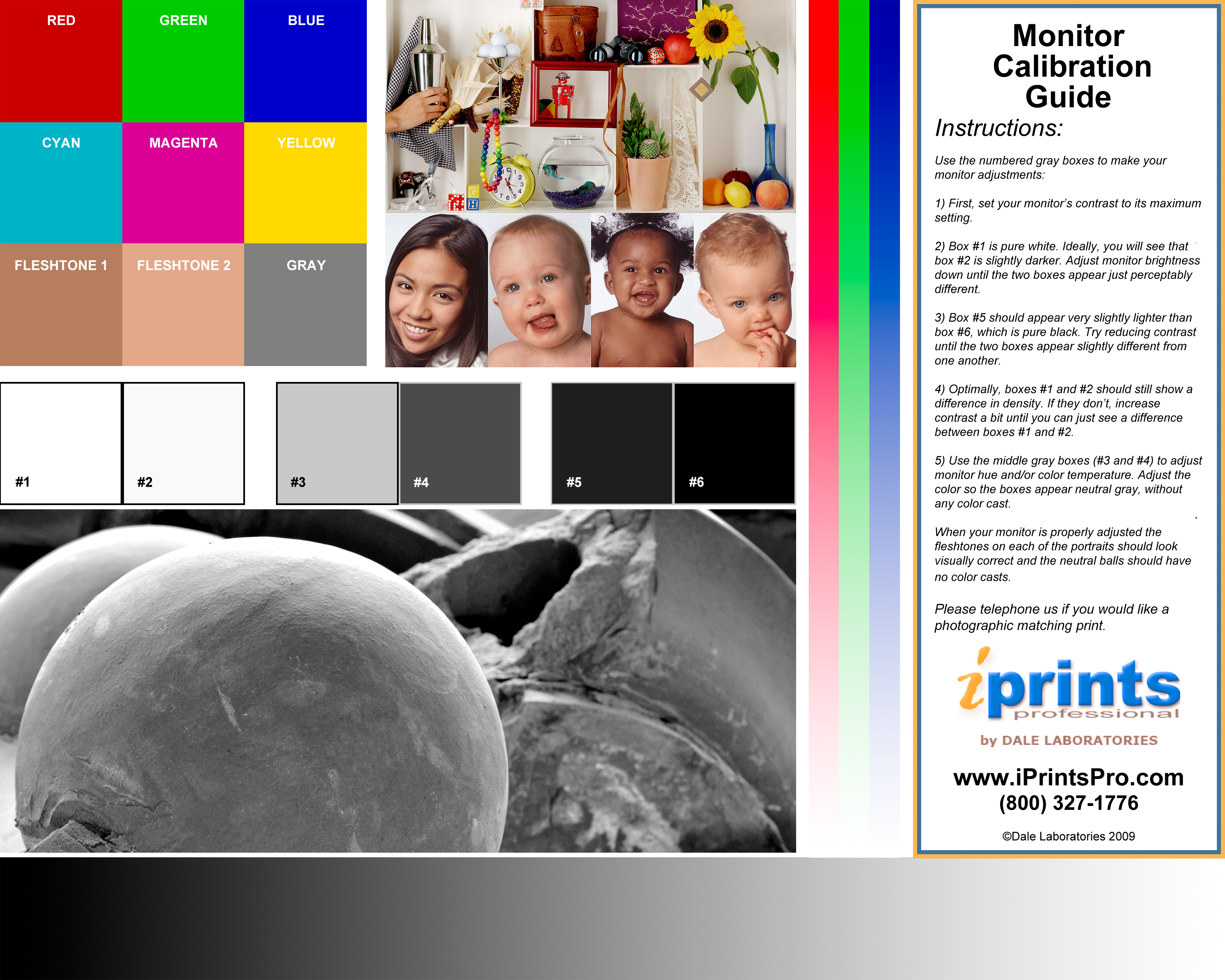
There is some interaction between brightness and gammaadjustments, so you may have to go back and forth between them. should look good, though I find the skin tones to besomewhat cool (very slightly blue) on my monitor. The image of the dog(center; the digital descendant of Victor's 'Nipper') should appear neutralgray except for the few specks of color. You may want to look at othercalibration images, such as the.Monitor size and resolutionsettingsStandard monitors have a diagonal to width to height ratio of5:4:3 (height/width aspect ratio = 0.75). Thanks to Pythagoras' theorem, diagonal 2 =height 2 + width 2; 5 2 = 32 + 4 2. That means that the width is 0.8times the diagonal and the height is 0.6 times the diagonal.Standard Windows screen resolution choices reflect this 4:3 ratio:800 x600, 1024 x768, 1152 x864, 1280 x960 and 1600 x1200 (pixels).Monitors are specified by their diagonal length.
Standard sizesare 14, 15, 17, 19 and 21 inches. But there's a rub: CRTmanufacturers cheat inspecifying the diagonal size! The use the outsidedimensions of the picture tube. The opening you see isone inch less than the specified monitor dimensions. MyHitachi 19 inch monitor is 18 inches diagonally.
LCD specs are morehonest.You should set your monitor's horizontal and vertical sizeadjustments for about 0.1 inch margins- about as large as youcan without cutting off the edges. Image sizes are shown inthe table below.You should set screen resolution for between 72 and 100pixels per inch.
If you set it for less than 72 pixels perinch, you won't be making use of your monitor's capabilities-your image will have less detail than it should. If you set itfor more than 100 dpi, you may be sending more detail thanyour monitor or eyes can resolve. To adjust screen resolution,right-click on the Windows wallpaper (the background outsideany open windows), then click on P roperties, Settings. Suggested monitorresolution settings are shown in the table below-recommendations are in boldface (the higher resolution,90+ ppi, is for younger eyes).Specified monitorsize (inches)Horizontal(inches)Vertical(inches)RecommendedresolutionPixelsper inch14x6007815x60393174x761911914.210.1x115.811.601I recommend at least a 17 inch monitor and at least 1024 x768 resolution.
If youincrease resolution and fonts are too small, you can adjust them byright-clicking on the Windows wallpaper, then clicking on P roperties, Appearance. Details depend on theoperatingsystem.Test imagesA good test image is useful for evaluating your monitor's quality andcalibration as well as the match between the monitor and printer. I founda nice image on The Digital Dog's website. Go to andshift-click or right-click on. Winzip (or a similar utility)must be installed on your system to turn this file, whose default name is, into a JPEG.
The1600 x2000 pixel image, shown greatlyreduced on the right, includes a portrait with good skin tones, color andgrayscale step charts, and the color rendition chart. ( hasColorChecker RGB values for variouscolor spaces- sRGB, Adobe 1998, etc.; has an outstandingdescription of the ColorChecker.) While you're at Digital Dog's site,check out his many excellent articles and tutorials.
Color management information:The file has an embedded ICC profile tag for Apple ColorMatch color space(gamma = 1.8). In non-ICC aware applications, or in ICC-aware applicationswith color management turned off, this tag is simply ignored.
No problem.But if you are using color management you must be aware of it. You shoulduse an ICC printer profile rather than Color Controls settings, asdescribed below. Because when color management is enabled, there is atranslation between the file color space and the monitor (display) colorspace. Other files, without profiles or with different profiles, translatedifferently.
The Color Controls settings ignore the profiles- notranslation takes place; the relationship between print and monitorappearance won't be consistent. But all will be well if you use an ICCprinter profile (that's what they're for).
I don't recommend converting toanother color space, though simply removing the profile tag doesn't domuch damage (the Gretag Macbeth Colorcheker displays slightlydark).Another standard test image (below, right) originated with PhotoDisc,Inc., which has been absorbed into (no connection with the ). They have a nice page of.
A 10 MB( large) high quality JPEG of thisimage can be downloaded from - one of my favorite sources of printingmaterials. The image size is 3225 x5055pixels. The colors are unsaturated (far from Velvia), apparently becausethe file data is for the Adobe RGB (1998) color space (see for an explanation of color spaces), but the file containsno embedded Adobe RGB (1998) profile. (Also, most web browsers do notrecognize profiles- they assume all images are in the default sRGB colorspace.) Color management information:The file (PDI-Target.jpg) has no embedded ICC profile tag. The file dataisfor Adobe RGB 1998. That's why colors appear unsaturated in web browsersand image editors that assume sRGB file data. To get proper appearance-correct saturation- in a, you must add an ICC profile tag without changing the imagedata.
In Picture Window Pro, you do this by clicking Transformation, Color, Change ColorProfile., then setting New ColorProfile: to SMPTE-240M (or Adobe RGB, which is identical) and Change: to ProfileSetting Only ( not the default).The has a very nice 2.6 MB 1080 x1680 pixel TIFF test image. A 686 x539 pixel test image which can be from is shown.These color balance and tonalities of these images can give you aqualitative indication of how well your monitor is calibrated. They canalso be used for checking.An excellent opportunity to collect high qualityphotographic prints and support this website.Gammaand black levelGamma describes the nonlinear relationshipbetween the pixel levels in your computer and the luminance of your monitor (thelight energy it emits) or the reflectance of your prints.
The equation is,Luminance = C.value gamma + black level C is set by the monitor Contrast control. Value is the pixel level normalized to amaximum of 1. For an 8 bit monitor with pixel levels 0 - 255, value = (pixel level)/255. Black level is set by the (misnamed) monitorBrightness control.
The relationship is linear if gamma = 1. The chart on the right illustrates therelationship for gamma = 1, 1.5, 1.8 and 2.2 with C = 1 and blacklevel = 0.Gamma affects middle tones; it has no effect on black or white.
If gamma isset too high, middle tones appear too dark. Conversely, if it's set too low,middle tones appear too light.
Note: Film is different. Gamma increases withdevelopment time; highlights are strongly affected.Gamma, as defined above, is also called displaygamma- the product of monitor's native gamma and video cardlookup table (LUT) gamma. (Most videocards have LUTs.) As we shall see, it is closely related to film gamma, which is the average slope of the.Black level isthe monitor luminance or print reflectance for value = pixellevel = 0; i.e., it is the deepest black in the monitor or print.
It is aconstant that includes the effects of viewing flare (stray light). In good monitor viewing environments it can be very small, lessthan 0.01, relative to a normalized maximum Luminance of 1.
It's also around0.01 for high quality prints (higher for mediocre paper/ink combinations).Sometimes black level appears inside the exponent,but it makes little difference since it's a constant.Geeks only! The correct gamma equationfor sRGB color spaceThe simplified, ideal equation for thesRGB color space (the standard color space of Windows and the Web;gamma = 2.2) isy = x 2.2, where yis the luminance and x is the normalized pixellevel.Butthe correct equation from the isy = x/12.92 for x Web Content Use ColorSync. If the box is checked, clearit and reload the page. Colorsync can't be disabled in the Safari(OS X) web brower.With 'Use ColorSync 'on, the chart indicated gamma = 2.2 on a system calibrated for gamma= 1.8 with a Colorvision Monitor Spyder and OptiCAL 3.5 software.With ' Use ColorSync' off, the correct gamma (1.8) is displayed. ForNetscape Communicator 4.7.7 for Classic Mac OS, which doesn't have acolor management option, the chart shows gamma =1.8.Setting gammaTo calibrate your monitor, i.e., to adjust gamma with any of thefollowing techniques, your video card should have a Lookup Table ( LUT). Most recent video cards have one.displays a pop-up message if no LUT is found.
If your video card doesn'thave one, it's ancient; replace it with a new one. It doesn't have to beexpensive or fast. 8 MB is the minimum video memory. 16 MB is faster forswitching between screens. Most cards have more.There are two basic approaches to adjusting gamma: the Visual approach, which uses a specialpattern, and the Calibratorapproach, which uses a colorimeter or 'Spyder TM.' TheColorVision Spyder is shown on the right.
The two approaches are comparedin the table below.ApproachVisualCalibratorAdvantagesIt's free! And it can do a good job ofcalibrating most monitors.Extremely accurate. Producesmonitor profiles for use with color-managed workflows.Programs:an excellent little utility. Recommended.Adobe Gamma: includedwith Photoshop.: a nice Linux utility.: doesn't require theinstallation of a new program, but can be inconvenient.Calibrators are designed towork accompanying calibration software. Examples:Some of these programs canperform an optional Visual calibration if a calibrator isunavailable.CommentsCan achieve excellent resultsif your monitor is well-behaved, i.e., if its luminance is proportional to(pixel level) gammanative.
If its response is irregular- dueto aging or malfunction- you'll need a calibrator (or a newmonitor).Can achieve excellent resultswith a wider range of monitors- the curves entered in the LUT can be morecomplex than the simple exponentials used with the Visualapproach.You can set your monitor to6500K (or sRGB, which is 6500K), but accuracy may be poor. This is rarelya major issue because the eye adapts when it moves from the monitor to theprint, which is typically displayed at 5000K or lower.
If the appears to be neutral gray on the monitor, it's fine;you'll be able to match prints. If it has a color tint you'll need to geta calibrator (or a new monitor).You can calibrate themonitor's white point to exactly 6500K. This is not a major advantage. Seecomments on the left.Not ideal for colormanagement, but you can achieve respectable results using sRGB as the.Best for color managementbecause you'll get a monitor profile that represents the true performanceof your monitor (which is close to sRGB for typicalCRTs).If you are starting out I recommend thevisual approach. It's fast, simple, and provides good results in mostcases.is a particularly nice little Windows utility for visual calibration. (is a comparable Linux program.) You can verify its accuracy with the.
If it is smooth neutral graywhen viewed from a distance, your monitor is well-calibrated and can't beimproved by much.If you want the ultimate in monitor-print matching or you can'tget good calibration with the visual approach, get a calibratorand upgrade to aworkflow. And many other authors stronglyrecommend this approach. But the improvement over the visual approach maybe modest because the Windows-default sRGB color space is close to typicalCRT monitors calibrated for gamma = 2.2.My friend recommends the, which sells for $249 US. OptiCAL software is excellent andthe new Spyder has seven filters instead of the usual three- it is a truecolorimeter, i.e., it can measure the human eye's response to color. Thisprobably makes little difference for CRTs, all of which have similarphosphor responses, but it can be advantageous in calibrating LCDmonitors, which can have very different spectral responses. By 2005virtually all new monitors will be LCDs: they've gotten very goodand new production capacity will drop the cost below CRTs.Calibration and profiling: the source of theconfusion(forcolor-managed workflowsonly)An image can be altered in two places onthe way to the monitor.
(1) by the video lookup table (LUT).This is performed by all thecalibrationtechniques below. (2) by gamut mappingin color-managedworkflows, performed by the color engine (CMM) under thecontrol of an ICC monitor profile.
Best Monitor Calibration Software
Seeand for more detail.The LUT is normally loaded with values thatenable the display to operate at the gamma (usually 2.2)specified by the calibrationprocess.Confusion arises because bothtransformations take place in color-managed workflows, andboth are controlled by an ICC monitor profile. Linksfrom W3C - The World Wide Web Consortium.byCharles Poynton - Definitive and detailed explanation of gamma. Somewhatdense reading.by PeteAndrews - Highly recommended.- More detail, covering gamma of the whole system. Mirroredby.- Robert W. Berger's contribution.fromincorporates material from this page.by Ian Lyons. Mentions how therecommended Macintosh gamma setting has changed from 1.8 to 2.2. visits tothis pagesince November 18,2001Imagesand text copyright © 2000-2005 by.Norman Koren lives in Boulder, Colorado, where he worked in developingmagnetic recording technology for high capacity data storage systems until2001.
Lcd Screen Calibration
He has been involved with photography since1964.